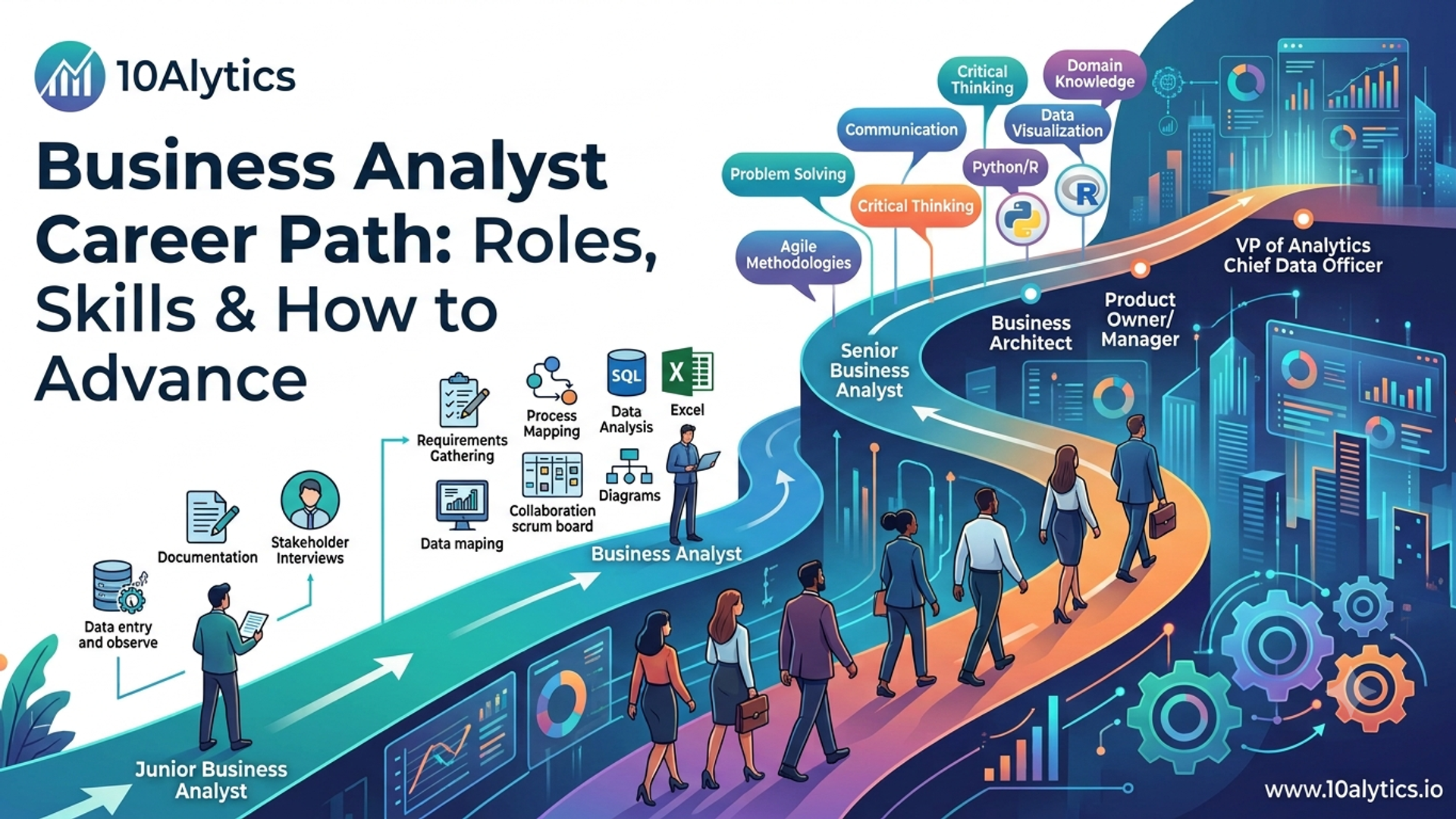
Business Analyst Career Path: Roles, Skills & How to Advance
Five years ago, when I first decided to transition into tech, I felt completely lost.
I saw endless job titles, opened a Business Analyst job description and thought:
“This sounds interesting, but where do I even begin?”
If you're asking the same question today, you're not alone.
The Business Analyst career path can look confusing when you're starting out. You may see titles such as Junior Business Analyst, Business Analyst, Senior Business Analyst, Product Owner, Business Systems Analyst and Business Analysis Consultant and wonder how they all fit together.
The good news is that you don't need to have your entire career mapped out before you start.
Business Analysis is a career built around problem-solving, communication, critical thinking, requirements gathering and process improvement. These skills are useful across industries, which is one reason the profession attracts career changers from backgrounds such as finance, healthcare, education, customer service, administration and marketing.
In this guide, we'll break down the Business Analyst career path, what Business Analysts actually do, the skills you need, how career progression works, whether you need technical skills, and how you can start building your career.
What Is a Business Analyst?
A Business Analyst (BA) helps organisations understand business problems, identify opportunities for improvement, define requirements and work with stakeholders and delivery teams to develop effective solutions.
In simple terms, a Business Analyst connects business needs with practical solutions.
Imagine a company receives hundreds of customer complaints because its online ordering system is confusing.
A Business Analyst doesn't immediately say, “Let's redesign the website.”
Instead, they investigate.
- Why are customers struggling?
- Which part of the process causes the most frustration?
- What are customers actually trying to accomplish?
- How does the current ordering process work?
- What do employees experience when processing orders?
- What business outcome does the organisation want to achieve?
Only after understanding the problem can the BA begin recommending improvements.
That's one of the most important things to understand about Business Analysis:
The job isn't simply to suggest solutions. It's to understand the problem well enough to identify the right solution.
If you're interested in seeing how Business Analysts contribute to digital transformation, read our guide on how Business Analysts drive digital change.
Do You Need a Technical Degree to Become a Business Analyst?
One of the biggest misconceptions about Business Analysis is that you need a computer science degree or years of IT experience before you can become a Business Analyst.
That's not necessarily the case.
Business Analysts come from many different professional backgrounds because several of the skills required for the role are transferable.
For example:
- Teachers may already have strong communication and facilitation skills.
- Bankers and finance professionals may have experience analysing information and processes.
- Customer service professionals understand customer problems and communication.
- Administrators may already understand workflows, documentation and operational processes.
- Healthcare professionals often have valuable domain knowledge and experience working with complex processes.
- Marketers may bring research, communication and customer-insight skills.
What matters is learning how to apply those transferable skills to business problems.
You don't need to know everything before starting.
You need to be willing to learn.
The Business Analyst Career Path: From Beginner to Leadership
There isn't one single Business Analyst career path.
Your progression depends on your experience, industry, interests and the type of work you enjoy.
A common progression looks like this:
Beginner → Junior Business Analyst → Business Analyst → Senior Business Analyst → Lead/Principal BA → Consultant or Business Analysis Leader
However, there are also opportunities to move into related careers such as Product Owner, Product Manager, Scrum Master, Business Systems Analyst, Process Analyst and Operations Analyst.
Let's look at each stage.
1. Junior or Associate Business Analyst
This is often where people begin their Business Analyst career.
As a Junior Business Analyst, your focus is on learning how Business Analysis works in practice.
You may support senior analysts with:
- Requirements gathering
- Business process documentation
- Stakeholder meetings
- User stories
- Process mapping
- Research
- Data analysis
- Meeting notes
- Testing and validation
- Project documentation
At this stage, you aren't expected to know everything.
Your goal is to develop strong fundamentals and understand how projects move from problem identification to solution delivery.
This is also the stage where building a portfolio can make a significant difference.
Instead of simply saying that you understand requirements gathering, for example, you can demonstrate it through a practical project.
2. Business Analyst
As your experience grows, you move from supporting other analysts to owning Business Analysis activities yourself.
At this level, you may be responsible for:
- Leading stakeholder interviews
- Running requirements workshops
- Analysing business processes
- Creating requirements documentation
- Writing user stories and acceptance criteria
- Identifying business problems
- Working with developers and product teams
- Supporting testing
- Managing stakeholder expectations
- Recommending process improvements
This is where your communication and analytical skills become particularly important.
You aren't simply collecting information.
You need to understand what stakeholders are saying, identify gaps and translate business needs into information that technical and delivery teams can act on.
3. Senior Business Analyst
With more experience, you can progress into a Senior Business Analyst role.
The biggest difference isn't simply the job title.
Your level of ownership changes.
A senior BA may work on larger, more complex projects and take responsibility for difficult stakeholder relationships, complex requirements and strategic business problems.
You may also begin mentoring junior Business Analysts and influencing how Business Analysis is performed within an organisation.
At this stage, employers are often looking for someone who can do more than produce good documentation.
They want someone who can think strategically, challenge assumptions, manage ambiguity and influence decisions.
4. Lead or Principal Business Analyst
Experienced Business Analysts can move into Lead or Principal roles.
Instead of focusing only on individual projects, you may begin overseeing Business Analysis activities across multiple projects or teams.
Your responsibilities can include:
- Establishing BA standards and processes
- Mentoring Business Analysts
- Reviewing requirements
- Managing complex stakeholder relationships
- Supporting strategic initiatives
- Improving analysis practices
- Coordinating BA teams
This is where technical and interpersonal expertise begin to combine with leadership.
5. Business Analysis Consultant or Leader
Eventually, your career can branch in several directions.
Some experienced BAs become Business Analysis Consultants, working with different organisations and solving complex business problems.
Others move into leadership positions such as:
- Business Analysis Manager
- Head of Business Analysis
- Principal Business Analyst
- Transformation Lead
- Digital Transformation Consultant
Others move into adjacent careers.
For example, a Business Analyst who enjoys product strategy may transition into Product Management or Product Ownership.
Someone who enjoys delivery and team facilitation may move towards Scrum Master or Agile Project Management.
Someone interested in process optimisation may specialise in Business Process Analysis or Operations.
There is no single “correct” destination.
Your career path should reflect the type of problems you enjoy solving.
Business Analyst Career Paths You Can Explore
One of the most interesting things about Business Analysis is that the title can lead in different directions.