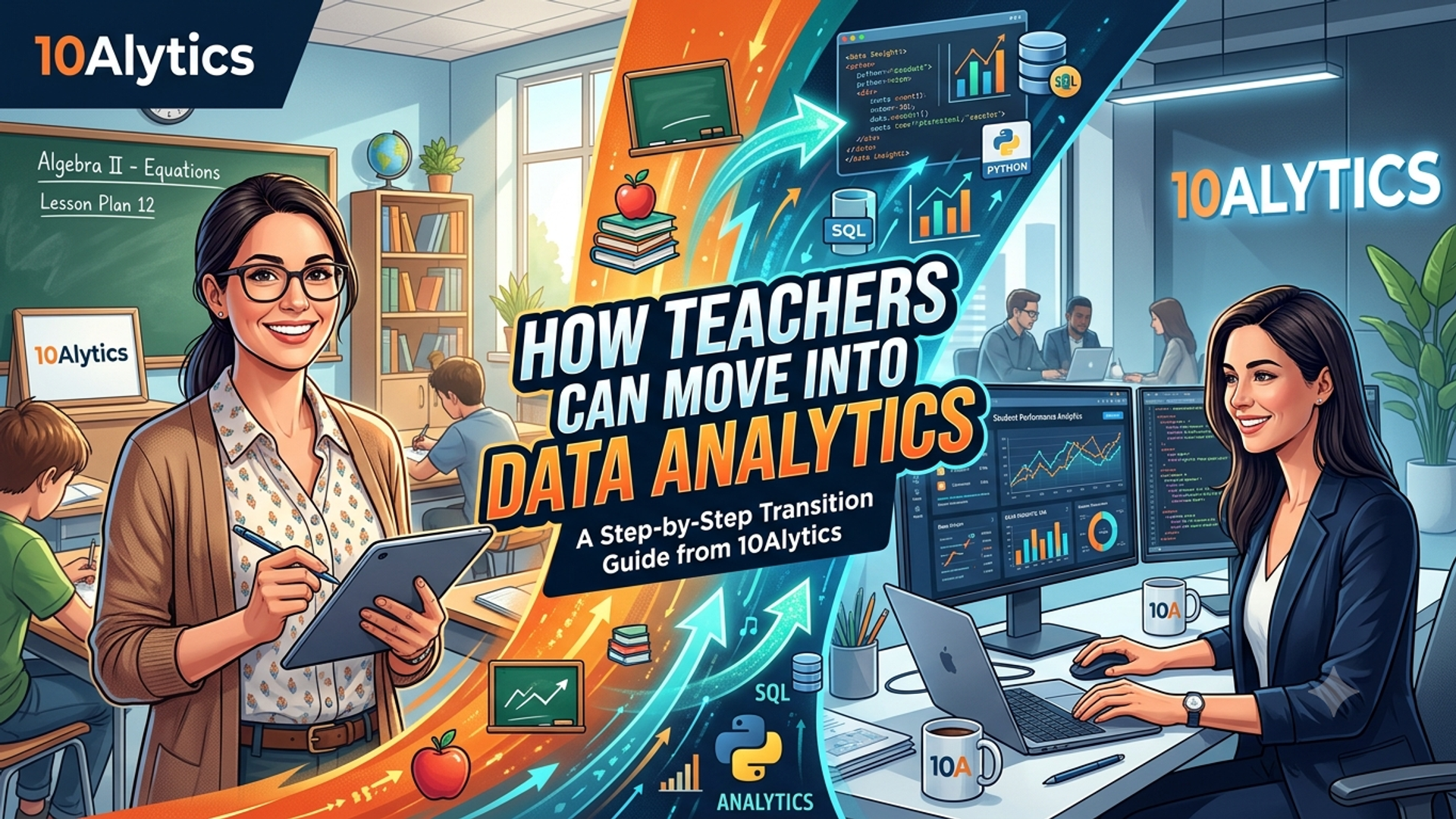
How Teachers Can Transition into Data Analytics
Teaching is fundamentally about data. Every time you grade a test, track attendance, or assess student progress, you are collecting and analyzing information. Because you already possess these core skills, transitioning from the classroom to a career in data analytics is much closer than you think.
Here is your step-by-step roadmap to making the switch.
Why Teachers Make Incredible Data Analysts
You don’t need a computer science background to succeed in data. Teachers inherently possess "soft skills" that companies struggle to find in traditional tech applicants:
Data Translation: You can explain complex concepts to an audience that doesn't understand them (just like explaining fractions to third graders).
Problem Solving: You are used to looking at low test scores, identifying the root cause, and pivoting your strategy.
Stakeholder Management: Managing parents, principals, and school boards prepares you perfectly for managing corporate executives and clients.
The 4-Step Roadmap to the Switch
1. Translate Your Resume
Stop using academic jargon. Rephrase your classroom experience into corporate, data-driven terms.
Instead of saying...
"Graded papers and tracked student progress." Say this... "Managed and analyzed student performance datasets to optimize learning outcomes."
"Designed the semester curriculum." Say this... "Created structured frameworks based on historical performance metrics."
"Met with parents to discuss behavior." Say this... "Presented performance insights to key stakeholders to drive behavioral improvements."
2. Master the Right Technical Tools
You don't need to learn everything at once. Focus on the core tech stack that companies actually use:
Advanced Excel: Move past basic spreadsheets. Learn VLOOKUPs, XLOOKUPs, and Pivot Tables.
SQL: This is the industry standard for talking to databases. Focus on querying, filtering, and joining data.
Tableau or Power BI: Learn to turn raw numbers into visual stories. (This is just a digital version of your classroom anchor charts).
3. Build a "Proof of Concept" Portfolio
Employers care more about what you can do than what your degree says. Create a public portfolio (on GitHub or NovyPro) featuring 3–4 projects.
Tip: Use publicly available education data (like school district spending or standardized testing data) to build your first dashboard. It bridges the gap between your past and your future.
4. Upskill with a Structured Program
Self-teaching is fine, but it can be overwhelming and lonely. Joining a structured bootcamp gives you a defined curriculum, hands-on projects, and a community of people doing the exact same thing.
Ready to trade the classroom for the boardroom?
At 10Alytics, we specialize in helping non-technical professionals transition into high-paying tech roles. Our Data Analytics Bootcamp gives you the exact skills, portfolio projects, and mentorship you need to make the leap.
Explore the 10Alytics Data Analytics Bootcamp →
Your Skills Are Valuable
The tech industry doesn't just need people who can code; it needs people who can think, communicate, and solve problems. As a teacher, you already do that every single day. The tech stack is just the tools, you already have the mind.