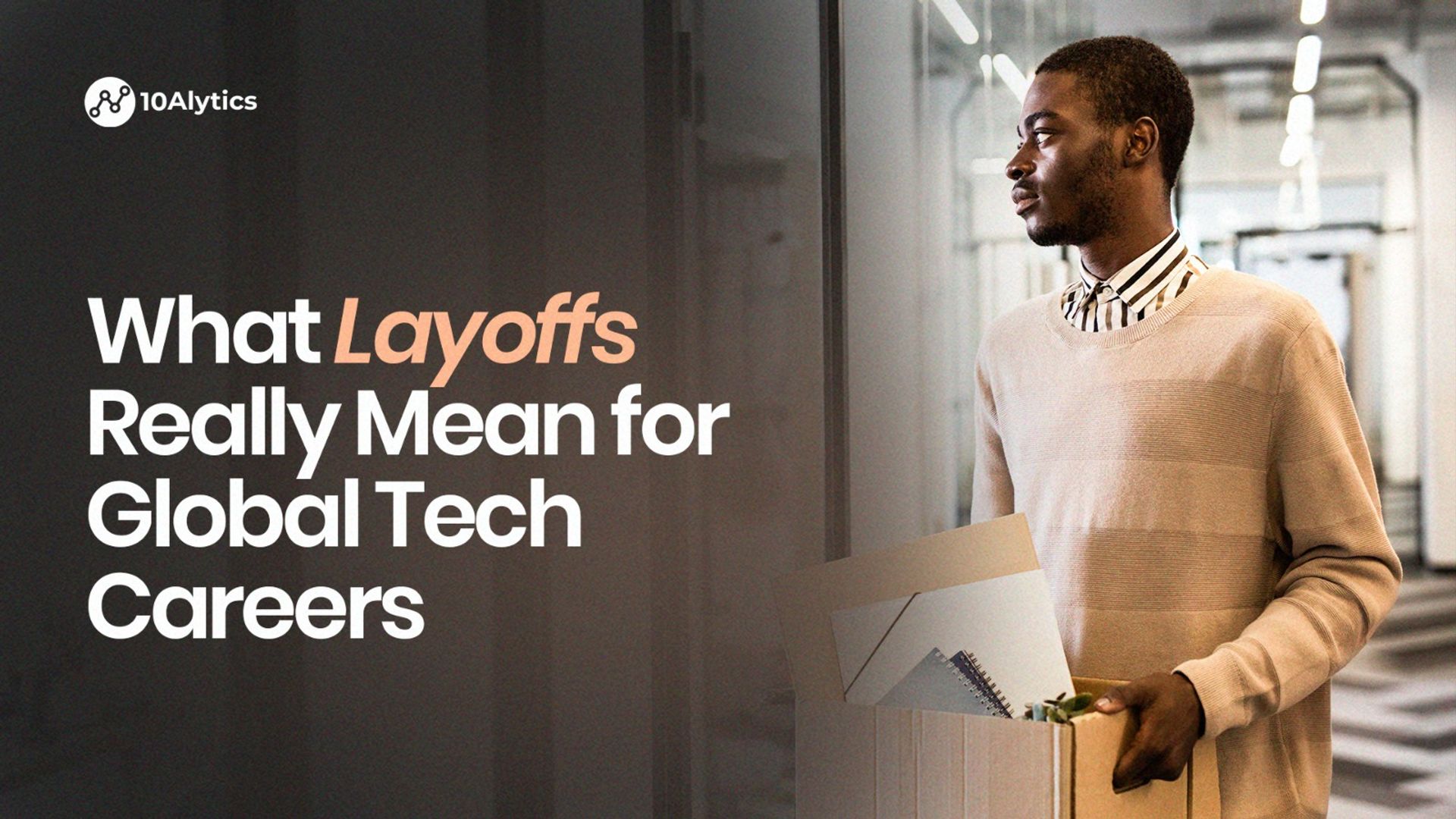
What Tech Layoffs Really Mean for Global Tech Careers in 2026 (And Why This Might Be Your Advantage)
If you’ve been following the news lately, it probably feels like the tech industry is constantly shedding jobs.
From Google to Meta and more recently Oracle, the headlines all seem to say the same thing: layoffs, restructuring, uncertainty.
And if you’re thinking about starting a career in tech—or trying to grow in it—you’ve likely asked yourself a very honest question:
“Is this still worth it?”
It’s a valid concern. But it’s also the wrong conclusion to draw from what’s happening.
Because what we’re witnessing in 2026 isn’t the collapse of tech careers. It’s a recalibration of the entire industry.
The Industry Isn’t Shrinking—It’s Shifting
It helps to think of the tech industry less like a stable corporate ladder and more like a living system—one that evolves quickly, sometimes uncomfortably.
Right now, companies are not simply cutting costs for survival. They’re repositioning themselves for what comes next.
Take Oracle as an example. Recent layoffs haven’t come from a place of decline, but from a deliberate shift toward cloud infrastructure and AI-driven services. The same pattern is visible across companies like Google and Meta.
Reports from Reuters and Bloomberg consistently point to one thing: these layoffs are less about the disappearance of jobs and more about the replacement of outdated roles with future-focused ones.
So the real story isn’t job loss. It’s job transformation.
Why This Feels Scarier Than It Actually Is
There’s something about layoffs that hits deeper than just numbers.
They create the feeling that the door is closing. That the opportunity is slipping away. That maybe you’re too late.
But in reality, what’s happening is the opposite.
The industry is becoming more selective, yes—but also more transparent.
In the past, you could rely on credentials, generic certifications, or even luck. Today, those shortcuts are fading. What’s replacing them is a system where your actual ability—what you can build, solve, and contribute—matters more than ever.
And while that raises the bar, it also removes a lot of the ambiguity.
You don’t need to guess what works anymore. You need to become undeniably valuable.
Global Tech Careers Haven’t Disappeared—They’ve Expanded
One of the most overlooked parts of this conversation is that while layoffs are happening in certain regions, global hiring hasn’t slowed down in the same way.
If anything, it has expanded.
Companies are still hiring across borders, especially for roles in data, engineering, and product. Platforms like LinkedIn continue to show strong demand for remote talent.
Which means something important for you:
You are no longer competing only within your location.
You are competing globally—but also accessing global opportunities.
That shift changes everything.
The Real Divide Isn’t Experience—It’s Preparation
Right now, there are two kinds of people watching these layoffs unfold.
The first group is waiting. Watching. Hoping things “stabilize” before they take action.
The second group is adjusting. Learning. Building.
And over time, the gap between them becomes impossible to ignore.
Because when hiring picks up—and it always does—it doesn’t reward those who waited. It rewards those who prepared.
This is where structure becomes everything.
Trying to navigate this shift alone can feel overwhelming. There’s too much information, too many paths, and too little clarity on what actually works.
But in the right environment, things start to click.
At 10Alytics, the focus isn’t just on teaching skills in isolation. It’s about helping you understand how those skills translate into real opportunities—how to build projects that matter, how to think like a problem-solver, and how to position yourself for a global tech career, not just a local job.
So, Are Tech Layoffs a Warning—or an Opportunity?
They’re both.
They’re a warning that the old, passive approach to building a tech career no longer works.
But they’re also an opportunity to enter the industry at a time when expectations are clearer, pathways are more defined, and global access is wider than ever.
The people who will benefit most from this moment aren’t the most experienced.
They’re the most intentional.
Final Thought: Don’t Read the Headlines—Read the Direction
It’s easy to get caught up in what’s being lost.
But the better question is: What is being built in its place?
Because that’s where the future is.
And if you align yourself with that future—if you focus on the right skills, the right environment, and the right level of preparation—then this moment won’t hold you back.
It will position you ahead